
WELCOME BONUS 300%
UP TO €2000 + 100
FREE SPINS
UP TO €2000 + 100
FREE SPINS
Home → Blackjack
Blackjack at Dude-Spin: Variants, Rules and Payouts
Bet two percent of bankroll per hand
A bankroll of €1,000 would suggest a maximum bet of €20 per hand, based on the two percent guideline. This strategy aims to prolong playing time and mitigate the impact of short-term variance. Adhering to this percentage can help players manage their funds more effectively over extended gaming sessions.
For a player with a larger bankroll of €10,000, the recommended bet per hand would rise to €200, maintaining the two percent rule. This proportional betting approach ensures that larger bankrolls can sustain higher individual bets without disproportionately increasing risk. Such a strategy is often recommended for disciplined players seeking to maximise their play.
The 'Bet two percent of bankroll per hand' guideline serves as a risk management tool, particularly relevant for games like Blackjack. This is distinct from the house edge, which for Blackjack Liberal Vegas Strip is 0.28%. While the house edge indicates the casino's long-term advantage, bankroll management controls the player's immediate risk.
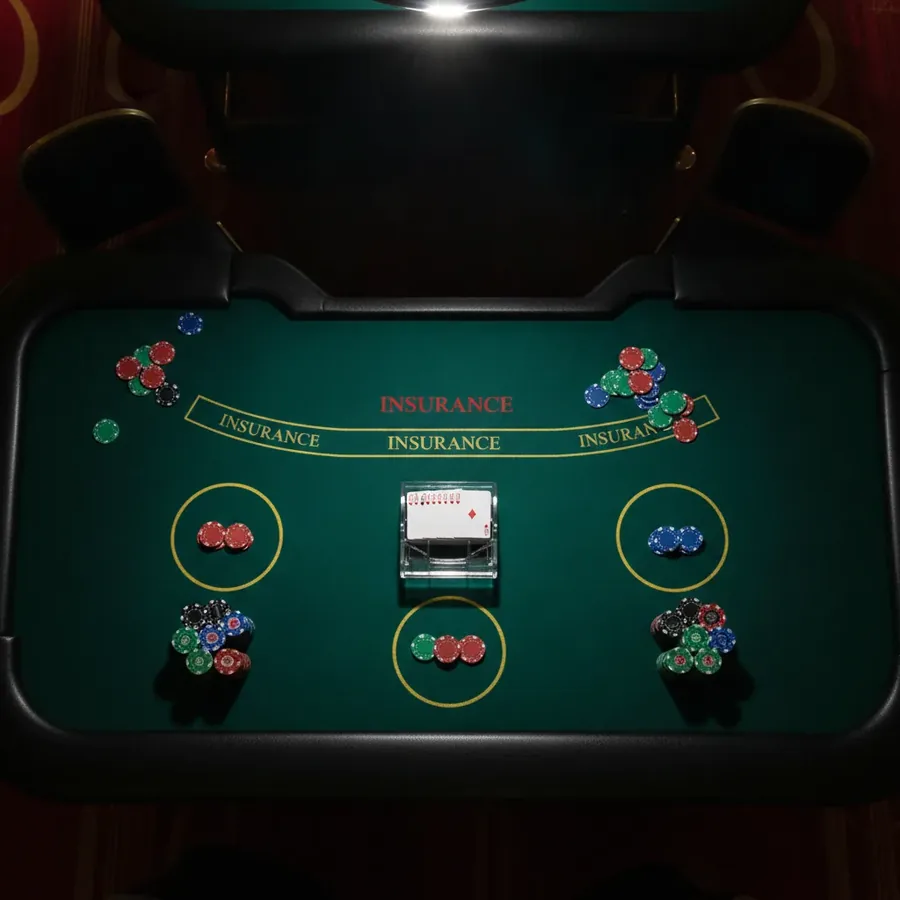
Statistics display saves the last 100 rounds
The statistics display retains data for the last 100 rounds of play, offering insights into recent game outcomes. This feature allows players to review patterns or sequences that may have occurred. For example, players can observe the frequency of certain hands or outcomes over this sample size.
For Blackjack 6 Decks, S17, DAS, which has a Return to Player (RTP) of 99.54%, reviewing the last 100 rounds could reveal deviations from expected outcomes. While RTP is a theoretical long-run average, observing recent rounds can provide a snapshot of short-term performance.
This 100-round history is independent of game-specific rules such as 'Late Surrender' in Blackjack Surrender, where the player forfeits half their bet. The statistics display focuses solely on recording outcomes, not on the strategic implications of specific game rules or modifiers.
16 vs 10 played incorrectly: most common error
A common strategic error in Blackjack involves incorrectly playing a hand totaling 16 against a dealer's upcard of 10. Many players incorrectly choose to stand on 16 in this situation. The optimal strategy dictates hitting this hand to improve the chances of a better total.
The house advantage for Blackjack 6 Decks, S17, DAS is 0.46%, and incorrect play, such as standing on 16 vs. 10, significantly increases this edge. Adhering to basic strategy is crucial for minimizing the house edge and maximizing player returns.
Playing a 16 against a 10 incorrectly can increase the house edge by as much as 1.95%. This is a substantial deviation from the intended house edge of 0.46% for Blackjack 6 Decks, S17, DAS. Mastering basic strategy is therefore paramount for serious players.
Blackjack Contributes Only 10 Percent to Wagering
When a welcome bonus is active, wagers placed on Blackjack games contribute only 10 percent towards the wagering requirements. This means that for every €100 wagered on Blackjack, only €10 will count towards clearing the bonus. This term is crucial for understanding how quickly bonus funds can become withdrawable.
This 10 percent contribution rate for Blackjack is a standard term across many online casinos, affecting the overall wagering process. For example, to meet a €1,000 wagering requirement, a player would need to wager €10,000 in Blackjack at a 10% contribution rate.
The contribution rate for Blackjack is significantly lower than for slot games, which typically contribute 100%. This disparity means players aiming to clear bonuses quickly may find slots a more efficient option, as €100 wagered on slots counts as €100 towards the wagering.
What Percentage Does Blackjack Count Towards Bonus?
Blackjack games contribute a mere 10 percent towards the wagering requirements of a bonus offer. This is a critical term to understand when accepting bonuses, as it directly impacts the effort required to make bonus winnings withdrawable. For a €2,000 welcome bonus, a player would need to wager €20,000 in Blackjack to meet the requirement.
The calculation for wagering is straightforward: a €10 bet on Blackjack contributes only €1 towards the wagering requirements. This is in stark contrast to slots, where a €10 bet would contribute the full €10. This difference is significant for players focused on bonus turnover.
This 10% contribution rate applies specifically to games designated as table games, including Blackjack variants. While games like Infinite Blackjack offer an RTP of 99.47%, their contribution to bonus wagering remains limited. Always check the bonus terms for specific game contributions.
Blackjack variants at a glance
| Variant | Payout | House edge | Rule | Bet range |
|---|---|---|---|---|
| Blackjack Split / Double / H17 – Regel-Effekte | n.a. (Regel-Modifikatoren) | H17 +0.22 Prozentpunkte; RSA −0.08 Prozentpunkte; DAS −0.14 Prozentpunkte | Dealer Hits Soft 17 verschlechtert RTP um 0.22 Prozentpunkte; Resplit Aces verbessert um 0.08 Prozentpunkte; Double After Split verbessert um ca. 0.14 Prozentpunkte; 6 Decks statt 8 – ca. 0.02 Prozentpunkte. | Double – Einsatz ×2 mit einer Karte; Split – bis 4 Hände; Ass-Split meist mit einer Karte. |
| Blackjack Insurance / Versicherung (6–8 Decks) | 92.53% | 7.47% | Separate Nebenwette bis 50% der Hauptwette, wenn der Dealer ein Ass hat. Basisstrategie schreibt IMMER Ablehnung vor (außer Karten zählen bei True Count ≥ +3). Bei einem Deck Vorteil ≈ 5.88% | Insurance 2:1 |
| Blackjack Auszahlung 6:5 statt 3:2 (6 Decks) | 98.15% | 1.85% | Ersatz von 3:2 durch 6:5 fügt exakt +1.39 Prozentpunkte zum Vorteil des Casinos hinzu – stärker als jede andere Regeländerung. Bei $10 Einsatz zahlt Blackjack $12 statt $15. | Blackjack 6:5, Gewinn 1:1 |
| Blackjack Ein Deck, klassische Regeln, 3:2 | 99.85% | 0.15% | Weniger Decks = niedrigerer Vorteil; ein Deck gibt ca. −0.48 Prozentpunkte gegenüber 8 Decks. Oft durch 6:5 Auszahlung kompensiert. | Blackjack 3:2, Gewinn 1:1 |
| Blackjack 6 Decks, S17, DAS, DOA, Auszahlung 3:2, Basisstrategie | 99.54% | 0.46% | Dealer steht auf Soft 17; Verdopplung auf jeder Zweierkarte; Verdopplung nach Split erlaubt; keine Aufgabe. Basisstrategie ist für diesen Wert zwingend | Blackjack 3:2, normaler Gewinn 1:1, Insurance 2:1 |
| Blackjack Liberal Vegas Strip (liberale Regeln, 3:2) | 99.72% | 0.28% | Günstigste Regelkombination: S17 + DAS + Resplit + Late Surrender. Standardabweichung 1,15 | Blackjack 3:2, Gewinn 1:1 |
Side Bets Increase House Edge to 5 Percent
Certain side bets can significantly increase the house edge. For example, Blackjack Insurance, when played with 6-8 decks, carries a substantial house edge of 7.47%. This contrasts sharply with the main game's advantage, which is considerably lower.
The decision to accept Blackjack Insurance is typically ill-advised for most players, with a stated RTP of only 92.53%. Standard strategy dictates avoiding this bet unless employing advanced card counting techniques with a true count of +3 or higher.
Opting for side bets can transform a low-margin game into one with a much higher casino advantage. At a 7.47% house edge on insurance, a player betting 10€ could theoretically lose 0.75€ per round on average, impacting overall bankroll.
Shoe, Cut Card, and 75 Percent Penetration
The use of a shoe with multiple decks is standard in many Blackjack variants, impacting the game's dynamics. For instance, Blackjack 6 Decks, S17, DAS, DOA with a 3:2 payout offers a 99.54% RTP and a 0.46% house edge.
Penetration, the point at which the shoe is reshuffled, also affects the house edge. A cut card placement determining 75% penetration means more cards are dealt before a reshuffle, which can slightly alter odds compared to deeper penetration.
Understanding these elements is crucial for players aiming to minimize the house advantage. A higher penetration generally benefits the player by reducing the casino's edge, making games like Blackjack 6 Decks more favorable than those with shallower penetration.
Seat change at the Live Table in 20 seconds
For players seeking immediate access, live dealer tables offer swift transitions. Infinite Blackjack, provided by Evolution, allows an unlimited number of players to join the game simultaneously, eliminating waiting times for a seat.
The efficiency of joining a live game is notable, with players able to participate within approximately 20 seconds. This rapid seat change is a key feature for those who prefer continuous gameplay without interruption.
This rapid availability ensures players can readily engage with games like Infinite Blackjack, which boasts a 99.47% RTP, without the frustration of waiting for a traditional seven-seat table to open up.
Soft 17: Dealer Hits or Stands
A critical rule variation in Blackjack concerns how the dealer handles a 'soft 17' (an Ace and a six). When the dealer hits on soft 17, the house advantage increases by approximately 0.22 percentage points.
Conversely, if the dealer stands on soft 17, this rule modification reduces the house edge. Blackjack Liberal Vegas Strip, featuring liberal rules and a 3:2 payout, has a house advantage of 0.28% and typically includes the dealer standing on soft 17.
Players should be aware of this rule, as it directly impacts the game's fairness. A game where the dealer stands on soft 17 is generally more advantageous for the player than one where they hit.
Infinite Blackjack vs Classic Seven-Seat Table
Infinite Blackjack, a live dealer game by Evolution, offers an unlimited player capacity, diverging from the traditional seven-seat Blackjack table. This format ensures no player needs to wait for an available seat.
While a classic seven-seat table adheres to fixed player limits, Infinite Blackjack provides a constant stream of action with an RTP of 99.47%. This allows for a more dynamic and continuous gaming session.
The key difference lies in accessibility and player numbers; Infinite Blackjack accommodates everyone instantly, whereas traditional tables might involve waiting periods, especially during peak hours.
Error insurance: 7 percent additional house edge
The Blackjack Insurance side bet, available when the dealer shows an Ace, carries a house edge of 7.47% for 6-8 decks. This deviates significantly from the main game's typical house edge.
This substantial house edge is considerably higher than the 0.46% edge found in Blackjack with 6 decks, S17, DAS, DOA, and a 3:2 payout. Players should note the elevated risk associated with this specific wager.
For players employing basic strategy, this bet is almost always to be avoided, as it erodes their overall return. Only in specific card-counting scenarios with a True Count of +3 or higher might it become marginally viable.
Splitting tens costs expected value: better stand
The decision to split tens in Blackjack, while sometimes tempting, can negatively impact expected value. Standard rules allow splitting up to four hands, but this action is not always optimal.
Compared to a Blackjack game with liberal rules like S17, DAS, Resplit, and Late Surrender (0.28% house edge), splitting tens can increase the house advantage. The base strategy dictates standing on a ten-value hand.
For example, the rule modification 'Double After Split' (DAS) improves RTP by approximately 0.14%. Splitting tens, however, introduces a scenario where standing on the initial 20 is the more financially sound choice for the player.
Side Bet Every Round: Budget Lasts 30 Rounds
Engaging in side bets on every round of Infinite Blackjack, which offers four such options (Any Pair, 21+3, Hot 3, Bust It), can rapidly deplete a player's budget. These bets are separate from the main hand.
With a maximum bet of €5,000 per round on Infinite Blackjack, a player consistently betting on side bets could see their funds diminish quickly. If a player consistently bets €100 on side bets across multiple rounds, their budget may only last approximately 30 rounds.
The RTP for Infinite Blackjack itself is 99.47%, but the RTP for side bets can be significantly lower, increasing the overall house edge for a player who frequently wagers on them.
How long does a Live Blackjack round take?
A round of Infinite Blackjack, offering unlimited player seats, typically takes longer than a standard table due to the nature of decision-making and betting. The game provider is Evolution.
While Lightning Blackjack also offers unlimited players and features multipliers up to 25x, the core gameplay duration is similar to Infinite Blackjack. Factors like player decisions and dealer actions influence the overall round length.
Blackjack Party, also from Evolution, features two hosts and aims for a lively atmosphere, but the actual time per hand is still subject to the players' speed and the dealer's pace.
When does the table max bet apply?
The table maximum bet for Infinite Blackjack is €5,000 per hand, as offered by the provider Evolution. This limit applies to each individual wager placed on the main hand.
For Blackjack Party, the maximum bet is €1,000, presenting a lower ceiling for players at this particular table. Players should be aware of these limits before commencing play.
Lightning Blackjack has a table max bet of €2,500, which is higher than Blackjack Party but lower than Infinite Blackjack. These maximums are enforced to manage risk for both the casino and the players.
Contact
Live - online chat
Banking









Providers












Dudespin 2026